
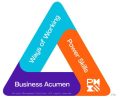
PMI Talent Triangle: Business Acumen
The Award Nobody Wanted
Eddie Monroe stood in front of a room packed with nearly a thousand people. The moment came to announce the Project Manager of the Year for his territory. Eddie called the name. The room went silent.
Not polite silence. Cricket silence.
After the meeting ended, fifteen people ran up to him. They had questions. No congratulations. Questions.
- Why did you choose him?
- Do you know how he talks to his team?
- Do you know what the customers say?
Eddie did not know. He looked at the numbers. End dates. Budget actuals. Completion rates. Every. Metrics. Spoke. WINNER. The room said something else entirely.
That moment changed how Eddie leads. It also explains why he built CCE Business Solutions on two principles that have nothing to do with the traditional project management trifecta of time, scope, and budget. At CCE, culture and customer experience are not buzzwords. They are the company names.
The Problem with the Triple Constraint
Most project managers were trained to define success one way. On time. On scope. On budget. That definition made sense when project management was a new discipline, and organizations needed a common language for delivery.
It does not make sense anymore. It may never have.
Eddie got his PMP in 2011. I got mine in 2004. We both lived through the era when the PMBOK and the experts teaching it tied project success directly to the triple constraint. And we both watched organizations apply that definition and still produce results that left clients frustrated, disengaged, and sometimes walking out the door.
The reason is straightforward. Clients do not care about your process. They care about their outcomes. When you finish a project on time and on budget, yet the stakeholders involved feel ignored, undermined, or overworked; you have not delivered success. You have delivered a timeline.
Executives See PMO Differently Than PMO Sees Itself
Here is what Eddie told me that every PMO leader needs to hear. “Executives see PMO as an extension of themselves. They expect the PMO to understand how the business works, not just how the project works. They expect business savvy. Financial awareness. Strategic thinking.”
When a PMO does not show that, executives start to see it as overhead. And when cost pressure comes, overhead gets cut. Eddie put it plainly: if you do not add value, you will be seen just over there.
That is not a harsh judgment. That is a business reality. And project leaders who think like entrepreneurs understand it instinctively.
The scope of work is a contract. Your project team is your workforce. Your stakeholders are your customers. Your budget is your P&L. When you frame your project that way, the decisions you make look different. The questions you ask look different. The way you show up looks different.
Adaptability Is Not a Soft Skill
One of the sharpest observations Eddie made was about adaptability. He described PMOs that have incredible documentation, thorough methodology, and detailed process of playbooks, and no credibility with the people they serve.
He worked with a Fortune 200 company where internal departments had started forming their own PMO. Not because they lacked support. Because they did not want to deal with the existing ones. The internal PMO was inflexible. It treated every project the same way. It required people to conform to its process rather than adapting its process to the project.
The result? People worked around it. They found other ways to get things done. They voted the PMO off the island.
Any entrepreneur knows where the customers are. You do not build a website and wait. You meet people where they are. You solve their actual problem, not the problem your process is designed to solve.
Your Brand Is Your Business
Eddie talked about brands in a way I have not heard enough project leaders talk about it. Your brand is not your LinkedIn headline. It is how people describe you when you are not in the room.
When he is hiring, Eddie looks for the intangibles. He wants someone with a sixth sense. Someone who can read a situation, feel when a pivot is needed, and move before the wheels come off. He wants someone who can run toward the fire, not away from it. And he wants someone who is sticky with their team, not just their clients. Someone who knows what their engineers like from Starbucks.
He also told me that he is looking for a gap in the resume. The person who got knocked down and got back up. Because resilience is a brand marker. It tells you something about how someone leads when things are hard, not just when things are smooth.
Financial Acumen Is Not Optional
This is one of the areas Eddie is most direct about. PMO leaders who want to be seen as an extension of the C-suite need to understand the financials. Not just the project budget. The business financials. Margins. EBITDA. The cost implications of decisions made inside the project.
He shared how he helped one PMO create a marketing metrics approach to communicate their value to leadership. Last year we closed 112 projects. This year we closed 178. Last year our margin was 21%. This year it is 29%. That is a language executives respond to. That is how PMO stops being a cost center and starts being a growth driver.
The IMPACT Driver Shift
Everything Eddie described in this conversation is the IMPACT Driver mindset in action. Stop reporting on outputs. Start driving outcomes. Stop asking stakeholders to adapt to your process. Start adapting your leadership to their needs. Stop talking about your value. Start creating it in ways people can feel.
51% of PMOs shut down within three years. The ones that survive are not the ones with the best templates. They are the ones with the clearest understanding of the business they serve and the courage to lead it that way.
Press play above and hear Eddie’s full story, including his free 90-minute PMO workshop offer for PMO Strategies listeners.

P.S. If leadership keeps questioning the value of your PMO, the problem is probably not your team. It may be your starting point. Join me on Tuesday, June 2 at 12:00 PM EDT | 5:00 PM BST for a free House of PMO webinar on how PMOs can become seen, trusted, and valued for the IMPACT they create. This is also a great opportunity to ask questions if you’ve been curious about IMPACT Engine Fundamentals, IMPACT Engine Practitioner, or the full IMPACT Engine System. Register for the free webinar here.