
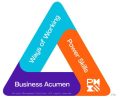
PMI Talent Triangle: Business Acumen
A few years ago, I was at a PMI event listening to PMO leaders compare the size of the portfolios they managed. One person said $50 million. Someone else said $100 million. Then $500 million. Eventually, someone said their portfolio was in the billions.
Those numbers represented enormous responsibility, but I said something the room did not love hearing: the size of your portfolio only tells me what the organization is spending. It does not tell me what the organization is getting back.
That is the difference between managing work and thinking like a business owner.
The business does not fund projects because it wants projects
Organizations invest time, money, energy, focus, people, technology, and sometimes reputation because they expect something to change. They may want more revenue, lower operating costs, faster decisions, stronger retention, lower risk, better customer service, or another measurable business outcome.
The project itself is not the outcome. The system, dashboard, training, process, report, or product is an output. It matters because of what it is expected to make possible.
That distinction sounds obvious until you look at how many projects are declared successful because the deliverable launched on time, within scope, and within budget. A team can do all of that and still miss the reason the work was funded.
In the episode, I use the example of a customer self-service portal. Imagine an organization invests roughly $1 million and six months to build it. The team delivers the full scope on time and on budget. Three months later, only 5% of customers have used it. Customer service calls have not fallen, and customer satisfaction has not improved.
Was the project successful?
Traditional delivery measures might say yes. The business outcome says no.
The organization did not invest because it wanted a portal. It invested because it expected customer behavior and service results to change.
Three questions that force the right conversation
When you think like a business owner, you keep coming back to three questions:
What are we doing?
Why are we doing it?
What does success look like?
The third question is where many teams stop too early. “Improve customer service” is directionally useful, but it is not yet a measurable definition of success. Reducing customer service calls by 20% within six months creates a much clearer target. Cutting an investment decision cycle from six weeks to two weeks creates another.
The exact metric will be different for different initiatives, and that is the point. A portfolio is not a collection of identical business cases. One initiative may exist to improve employee retention. Another may reduce cost. Another may increase revenue or reduce risk.
Trying to force every initiative into the same success metric can create the appearance of consistency while disconnecting the PMO from the business reason the work exists.
Once the expected outcome is clear, you can use time, scope, cost, and progress the way they were meant to be used: as information that helps the organization make better tradeoffs.
If a requested scope change costs another $100,000 but materially increases the expected return, the business-owner question is not simply, “What does this do to our baseline?” It is, “What does this do to the outcome and the return?”
That is a different leadership conversation.
Maximum utilization can be a warning sign
Business owner thinking also changes the way you look at capacity.
Many organizations treat full utilization as evidence of good resource management. Every person is assigned. Every hour is spoken for. The spreadsheet looks efficient.
The work barely moves.
I often use a highway at rush hour to make this visible. When every lane is filled and every inch of road is occupied, you have achieved maximum utilization of the highway. You also have a parking lot.
Nothing is in flow.
The same thing happens when critical people are split across five, ten, or twenty initiatives. Everyone is busy. Every project shows some activity. But people are constantly switching context, attending meetings, answering questions, waiting for decisions, and trying to remember where they left off.
The result is not faster strategy delivery. The result is more work in progress, more coordination, more waiting, and less throughput.
This is why adding more people does not automatically solve the problem. If the organization has too much work in flight, adding people to one part of the system may simply create another bottleneck somewhere else. You may still be waiting two weeks for the sponsor decision that the work needs to move.
A stronger capacity conversation
You may not have the authority to reject every new project that appears. You can still change the quality of the decision.
Instead of saying, “We do not have capacity,” bring choices.
Yes, we can add these three initiatives. We can finish two pieces of higher-value work first and then start them. We can move focused capacity from lower-value work. Or we can add the people required to protect current commitments.
Then show leaders what each choice means for timing, cost, and expected business value.
Now the PMO is not simply reporting a resource problem. You are helping leaders see the investment and return together and make an informed portfolio decision.
That is what a strategic thinking partner does.
Start with one initiative
Choose one initiative the organization is funding right now and apply the three questions. Be precise about what is being done, why it matters, and what measurable success looks like.
Then look at the investment around it. Are time, money, energy, focus, and people producing the outcome the business needs? Is the most important work getting enough focused capacity to move and finish? Or is it one more car sitting on an overloaded highway?
You do not need to redesign the entire PMO in one move. Fix the problem on one initiative, learn what works, and then turn that capability into a repeatable service across the portfolio.
Thinking like a business owner is not about pretending you own the company. It is about taking responsibility for the questions the people funding the work must answer: Is this worth doing? Is the investment producing the intended result? Are we focusing capacity where it creates the most value?
Those are the conversations that make you useful at the leadership table.
Press play above to hear the full episode and see how the three questions connect outcomes, capacity, flow, and stronger portfolio decisions.
P.S. If you want to think like a business owner, that same mindset has to show up when you make the case for your PMO.
Executives do not need another list of everything that is wrong, more detail about your governance process, or an explanation of what the PMO does. They need to understand the business problems the PMO will help solve, why solving them matters, and what support is required to make that happen.
That is exactly what I teach in my free training, How to Build a Business Case for a Strategy-Driven PMO. Register for the free training.