

PMI Talent Triangle: Power Skills
Why PMO Service Adoption Fails After a Successful Launch
Your launch meeting was full. Training completion is high. The templates are on SharePoint. Yet an executive still bypasses the prioritization process, a project owner finds the old intake form, and the governance meeting ends without the decision it was designed to produce.
On paper, the rollout worked. In the operating rhythm of the business, very little changed.
That gap is adoption, and it is where a PMO can choose the right service, solve the right problem, and still lose momentum and credibility. The business value does not appear when the process goes live. It appears when leaders and teams use the capability to make better decisions, focus limited capacity, move strategy forward, and realize the outcomes the work was meant to create.
A launch proves exposure, not adoption
PMO and transformation leaders often put enormous energy into the work before launch. We interview stakeholders, gather requirements, design the process, build the communication plan, identify champions, prepare training, and publish the tools. When launch day arrives, the project team celebrates and moves to the next priority.
For the people expected to use the new capability, that same day is day zero.
They are just beginning to discover where the process fits into their work and where it collides with reality. The step that sounded simple in training may require information they do not have. The dashboard may arrive after the leadership meeting where the decision was made. A sponsor may support the new process until it requires a difficult trade-off. An executive may bypass the intake path because the request feels urgent.
Attendance, completion, submissions, and logins can tell you that people were exposed to what you launched. They cannot tell you whether anyone is deciding or working differently because of it. A governance meeting can be perfectly attended, every status field can be complete, and every slide can be delivered on time. If leaders leave without resolving the capacity conflict or making the priority call, the organization is carrying the same problem into another month.
Define the behavior before you measure the rollout
The first question after a launch is simple: What are people supposed to do differently now?
The answer has to describe a behavior in the work, not activity around the tool. “Use the new form,” “attend the meeting,” and “update the dashboard” describe participation. They do not explain the decision, conversation, or outcome the capability is supposed to make possible.
For a new intake process, the behavior may be that leaders pause before assigning work and give the organization enough information to understand the request, the expected outcome, and the capacity required. For a portfolio review, executives may need to make real trade-off decisions instead of allowing every initiative to remain a priority. For a dashboard, leaders may need to use the information to decide what requires attention, what should change, and where a decision is needed.
This level of specificity changes how the PMO builds, communicates, and improves the service. It also gives stakeholders language they recognize. “Increase portfolio management maturity” may belong in an internal plan, but it does not tell a marketing leader that they will be able to see whether enough capacity exists before committing to a launch date.
When the intended behavior is clear, you can stop defending whether everyone followed every step and start measuring whether the capability is solving the problem it was designed to solve.
Stay close when the new way meets real work
Many teams do more stakeholder engagement before launch than after it. That is backwards if adoption is the goal.
Early users show you what happens when the new capability meets real deadlines, existing power structures, competing priorities, and habits that have been reinforced for years. Their experience helps you separate a communication problem from a design problem, a support problem from an accountability problem, and a temporary learning curve from something that genuinely needs to change.
Do not begin with, “Do you like the new process?” That question usually produces an opinion, and often a polite one. Ask someone to walk you through the last time they used it.
Where did they start? What happened next? Where did they get stuck? What did they do when they got stuck? Did they ask for help, work around the process, or abandon it? What would have made the next step easier?
Then listen.
This is the moment when many of us want to explain why every field and step is important. Resist that instinct. Feedback is not an attack on the work your team created. It is evidence about how the service is living inside the organization.
Some feedback will be an attempt to avoid the change. You are not required to remove every step someone finds inconvenient. Your job is to understand what sits underneath the reaction, protect the part of the change that creates value, and adjust what is getting in the way without lowering the standard the organization needs.
That is how you iterate your way to IMPACT.
Reinforce the new habit in the moments that matter
Adoption is tested when the old way feels faster.
Imagine that a leader ignores the new prioritization process and sends a request directly to a team. If the team accepts the work and the PMO quietly adds it to the portfolio, the old habit has just been reinforced. Everyone learned that the new process is optional when pressure is applied.
Another reminder email will not undo that lesson.
The response in that moment matters. The PMO may need to bring the request back into the prioritization conversation. The team may need support saying, “Yes, we can take this on, and we need a decision about what moves out first.” That makes the capacity consequence visible and keeps the trade-off where it belongs.
Stories reinforce the new behavior too. Show how the intake conversation prevented a team from committing to work it could not deliver. Show how the portfolio review stopped lower-value work and protected capacity for a strategic priority. Show how sponsor involvement helped a decision happen before it became a six-week delay.
People need to see how the new capability makes work easier, decisions clearer, and outcomes more achievable. That is what creates pull for the change.
Pace the change for absorption, not comfort
I learned this part the hard way.
A boss once told me, “You’re moving too quickly, and we’re struggling to keep up.” I was proud of how fast we were rolling out new PMO services. I could see every opportunity to help the organization, and slowing down felt like leaving value on the table.
The people around me were still trying to absorb what we had already introduced. They were breaking old habits, practicing the new way, and trying to do all of it while keeping up with everything else on their plates. Before those habits could take hold, I was already preparing the next rollout.
Another leader gave me an image I have remembered for decades. He told me the organization was still at C while I had already moved to Q. He knew I had the right answer, but if I wanted people to come with me, I had to return to C and lead them forward one letter at a time.
That does not mean waiting indefinitely for everyone to feel comfortable. It means setting a pace that accounts for the organization’s ability to absorb change. Give people enough space to practice the new behavior, reinforce why it matters, remove the friction you can, and use the evidence before building the next thing.
One conversation can show you what to do next
Choose one PMO service, process, governance rhythm, dashboard, or tool that should be creating more value than it is today. Find one person close enough to the work to tell you what is actually happening.
Ask: “Walk me through the last time you were supposed to use this. What happened?”
Do not turn the conversation into another training session. Listen for where the intended behavior breaks down, what the person did instead, which leader reinforced the workaround, and what would make the new way easier to use next time.
Then decide what needs to be clarified, changed, supported, or reinforced.
You put a great deal into building the capabilities your organization needs. Give that work the chance to create the value it was designed to deliver. The launch is not the finish line. It is the beginning of the leadership work that turns a new process into the way the organization operates.
Press play above to hear how to close the gap between “we launched it” and “this is how we work now.”
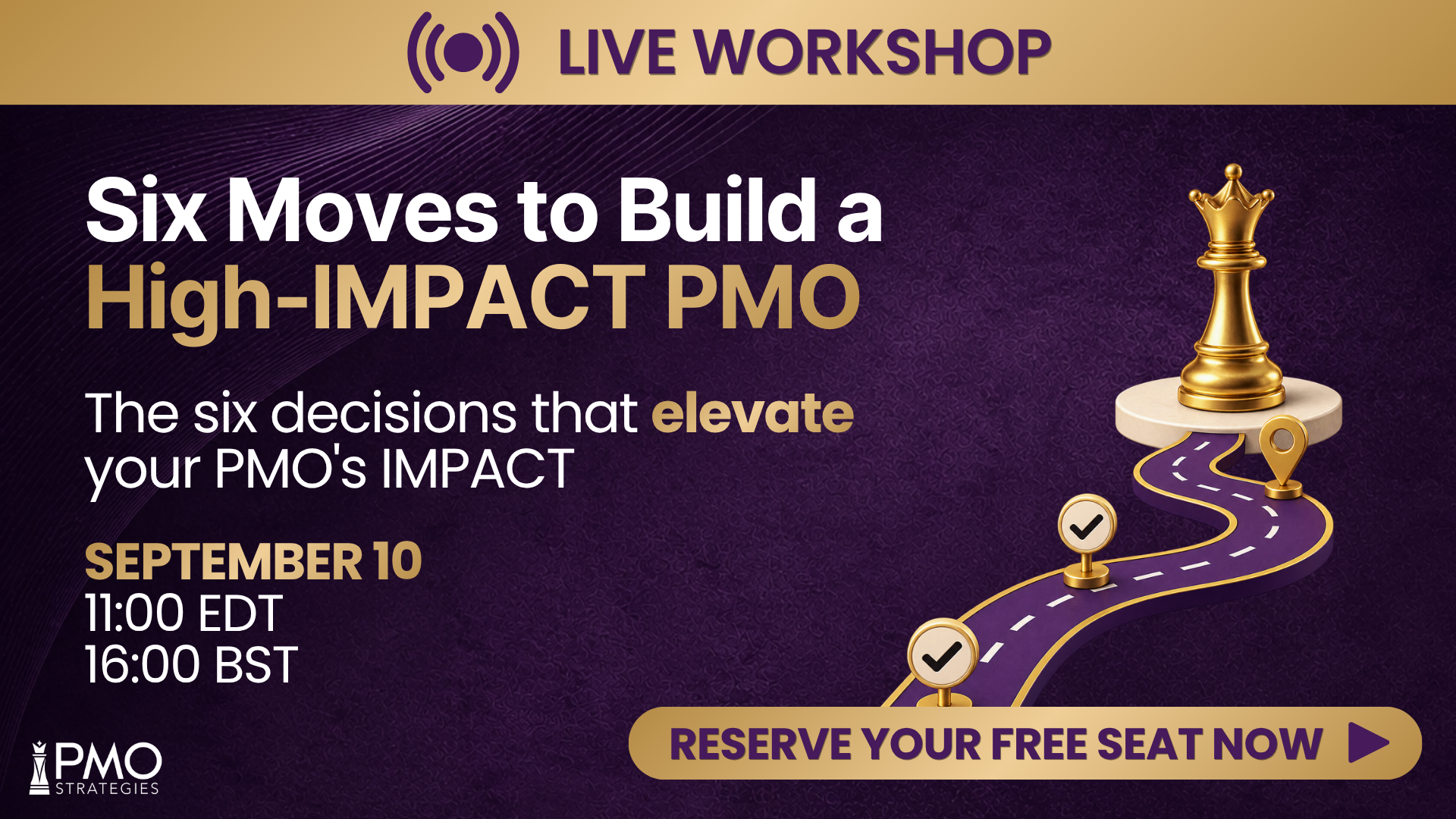
P.S. Join me live on Thursday, September 10, for Six Moves to Build a High-IMPACT PMO, a FREE two-hour workshop from 11:00 a.m. to 1:00 p.m. EDT | 4:00 to 6:00 p.m. BST. We’ll work through what is really driving the visible problems so you can leave knowing where to focus first and what to do next. Every registrant receives the Six Moves Workshop Workbook. Register for the free workshop.