
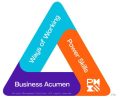
PMI Talent Triangle: Business Acumen
AI experimentation is becoming an enterprise portfolio problem
The first wave of enterprise AI was allowed to be messy. Teams tested tools, built pilots, experimented with agents, automated pieces of work, and tried to figure out what was possible. That exploration created useful learning, but it also created a problem many organizations can no longer ignore: AI activity is spreading faster than leaders can see how the pieces connect.
At some point, the questions change. What are we spending? Which initiatives support our strategic priorities? What business outcomes are we expecting? Where is the funding coming from? Which use cases should scale? Which should stop? What risk are we carrying?
Those are not technology questions. They are enterprise portfolio questions.
That is why I invited Cedric Fiederer into this conversation. Cedric is a former management consultant and Fortune 500 executive with more than 15 years of experience in portfolio management and business transformation. His perspective matters here because the organizations that get value from AI will need more than experimentation. They will need the decision discipline to connect investment, capacity, risk, and outcomes.
The AI budget has to come from somewhere
One of the most useful points Cedric makes in this episode is also one of the simplest: a dollar spent on AI is still a dollar.
Organizations do not suddenly get unlimited capacity and unlimited funding because the technology is exciting. As AI investment grows, leaders have to make the same kinds of choices they make everywhere else in the portfolio. Do we put the next million dollars into AI, an ERP upgrade, a new R&D center, additional sales capacity, or a different strategic priority?
That is the point where AI stops being a side experiment and becomes part of the enterprise investment conversation.
If the PMO is already helping leaders understand portfolio priorities, funding, capacity, and tradeoffs, then AI does not need an entirely separate logic. It needs to be brought into the same enterprise decision system.
This is also where a PMO can create strategic value quickly. The value is not in building a new reporting machine around AI. It is in helping executives see what they are funding, why they are funding it, what the investment is expected to change, and what they are choosing not to do as a result.
Visibility comes before control
When leaders hear “AI governance,” they may picture another committee, more gates, or a long approval process that slows everything down. That is not the point Cedric and I are making.
The first move is visibility.
What AI initiatives are already underway? What is being spent? Which efforts are tactical, which are transformational, and which are simply experimentation? What strategic priority does each initiative support? Is the expected value cost reduction, revenue growth, improved capacity, risk reduction, or something else?
That basic portfolio view can expose duplication, missing ownership, unclear value, and unexamined tradeoffs before anyone creates another layer of process.
It also gives the PMO something far more useful than a list of projects. It creates an executive decision picture.
Once leaders can see the portfolio, the PMO can help ask the next set of questions. Which initiatives deserve additional investment? Which should be stopped? Which should be scaled across business units? Where are we paying multiple teams to solve the same problem? Where is one team producing something the rest of the organization could use?
That is how the PMO moves from reporting activity to improving enterprise decisions.
AI governance also means risk and accountability
The conversation cannot stop at cost and value.
Cedric also raises the compliance and workforce implications that become visible when AI initiatives are mapped at the enterprise level. International organizations may have different legal and regulatory obligations across markets. Some AI initiatives can create workforce implications that leaders need to understand early, not after a major change is already underway.
The PMO does not need to become the legal department or the HR function. It does need to make sure those decision dimensions are visible in the portfolio and connected to the right owners.
This is the difference between useful governance and governance theater.
Useful governance helps leaders make better decisions. It makes important tradeoffs visible. It brings the right expertise into the conversation. It clarifies accountability. And it keeps strategic outcomes at the center of the work.
The opportunity is bigger than AI
There is another reason I want PMO leaders paying attention to this moment.
If your organization does not have an enterprise view of AI, this is an opportunity to demonstrate why an enterprise view matters in the first place.
In the episode, I talk about what we see inside organizations all the time: several teams trying to solve the same problem while another part of the business has already figured it out. Without enterprise visibility, teams duplicate effort and leaders lose the opportunity to scale what is working.
Cedric shares an example from an automotive organization where the PMO helped identify valuable practices in one location and replicate them globally. That changed how the PMO was perceived. It was no longer just the group asking for justification and running review boards. It became the group finding value and helping the organization spread it.
AI creates the same opportunity.
Your PMO can help identify the use cases that are actually working, connect them to measurable outcomes, and help the organization scale those “gold nuggets” instead of paying to rediscover them somewhere else.
Where to start
If your PMO has not been deeply involved in the AI conversation, start with one question: does anyone currently own the enterprise view of AI budget and governance?
If the answer is yes, find out how that capability connects to the broader enterprise portfolio. If the answer is no, you have an opening.
Bring leaders a simple picture of what you can see. What is being spent? What initiatives are in flight? What strategic outcomes are they intended to support? Where are the biggest tradeoffs, risks, overlaps, or opportunities to scale?
Then propose the PMO as the capability that helps maintain that enterprise view and improve the decisions around it.
Do not wait for a perfect AI governance model before you begin. Start by helping leaders see the decisions they cannot make well today.
That is the strategic opportunity in front of the PMO right now.
Press play above to hear my full conversation with Cedric Fiederer and see how to turn scattered AI activity into an enterprise portfolio conversation.

P.S. If you want to continue this conversation, join me and Rod Hughes from Planview for From AI Activity to Enterprise Impact: The PMO’s New Role in AI Transformation on Thursday, October 29 at 10am CT / 4pm GMT. The live webinar will go deeper into how PMOs can help leaders connect AI investment decisions to strategy, capacity, execution, and measurable business outcomes