
PMI Talent Triangle: Business Acumen
AI is creating a strategy-delivery problem before it creates a technology problem
AI is making it easier for people across the organization to generate ideas, prototypes, automations, and new ways of working. That sounds like progress, and it can be. But for PMO and transformation leaders, it creates a second-order problem that is easy to miss: the organization can now create potential work faster than its existing operating model can evaluate, prioritize, resource, and learn from it.
Many PMOs were already trying to manage too many projects, unstable priorities, limited capacity, and leaders who believe their newest request belongs at the top of the list. Add an explosion of AI-enabled ideas to that environment and the old intake-and-governance model starts to creak very quickly.
That is exactly why I wanted to have this conversation with Marc Chabot, Co-founder and CEO of ForceEquals. Marc is working at the intersection of AI, strategy, and project portfolio decision-making, and our conversation explores what changes when organizations can generate ideas faster, strategy moves more dynamically, and the PMO has to help leaders make better choices about what moves forward.
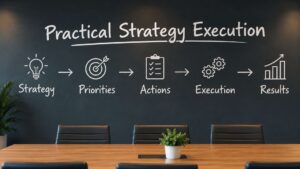
This is why the AI conversation cannot stay at the level of tools. The strategic question is how the organization will connect changing strategy to the work it chooses, the work it stops, the tradeoffs it makes, and the lessons it brings back into the next strategy decision.
Strategy is becoming more dynamic. Your operating model has to keep up.
Marc made an important point in our conversation: strategy used to be treated as something leaders could define annually and revisit periodically. That rhythm is getting harder to defend when competitive conditions, customer expectations, technology capabilities, and AI opportunities are shifting so quickly.
For the PMO, this changes the job. If strategy is moving more frequently, the portfolio cannot be a static list that gets prioritized once and then defended for the rest of the year. The PMO needs a way to help leaders understand what the current strategy means for the choices in front of them right now.
That is where AI can be useful. It can help bring together strategic context, project information, constraints, and changing assumptions at a scale that would be difficult to manage manually. But the technology does not make the decision. The value comes from giving leaders better decision support and helping them understand why one initiative belongs above another, where capacity is constrained, and what new information should change the plan.
Stop making stakeholders do the PMO’s homework
One of the clearest examples in this episode came from a client I worked with whose project-intake process started with a 45-question form. The PMO had built the process, connected the technology, and created the governance. The problem was that nobody wanted to use it.
That kind of process can look disciplined from inside the PMO and feel like a wall from everywhere else.
The better question is not, “How do we force people to complete the intake correctly?” It is, “How do we help them get to the information we actually need?”
I often boil that starting point down to three questions:
- What are you doing?
- Why are you doing it?
- What does success look like?
Once you have that much context, the PMO can become the guide. AI can help surface missing questions, shape an early business case, identify stakeholders, suggest risks, and expose assumptions. Then the PMO leader can spend more time on the conversations that require judgment instead of policing whether every field was completed.
That is a very different experience for the stakeholder. Instead of telling them to do all their homework before they are allowed into the process, you stand beside them and help them build a decision-ready idea. That shift changes how the PMO is experienced by the business.
Prioritization gets stronger when leaders can see the tradeoff
The next problem is familiar: everything is a priority until something has to give.
A prioritized list does not create focus if leaders can bypass it every time a new pet project appears. When the portfolio is already operating like a six-lane highway at rush hour, adding more cars does not create more throughput. It creates a bigger traffic jam.
This is another place where AI can help, especially when the project volume becomes too large and too dynamic for a spreadsheet to reflect the real situation. An AI-assisted system can compare initiatives with strategy, constraints, dependencies, capacity, and other projects. It can help surface clear fits, clear mismatches, and the projects that need human judgment because the answer is not obvious.
The important leadership move is what happens next. The PMO can take that information into an executive conversation and make the tradeoff visible. “Here is what this new initiative is competing with. Here is the capacity it would consume. Here is the strategic outcome the displaced work supports. If we move this up, this is the decision we are making.”
That is Strategy Navigator work. You are not trying to win an argument about your scoring model. You are helping leaders make an informed business decision.
AI guardrails are not only controls. They are learning signals.
The conversation gets even more interesting when the project itself is an AI initiative.
Marc described guardrails at multiple levels: how an agent operates, how connected agents operate together, how humans enter the loop, and how the organization responds when something happens outside the expected path. Those controls matter, especially in environments where risk, regulation, and accountability cannot be treated casually.
But every exception is also information.
An AI agent will not behave perfectly in the real world on day one. It will surface cases nobody anticipated. Humans will intervene. Rules will be questioned. New opportunities will appear. If the PMO stays connected through that operational phase, those signals can become inputs to the next strategy conversation.
That is the larger strategy lifecycle. Delivery does not simply end in deployment. What the organization learns in operation should inform what it prioritizes, changes, stops, or explores next. The faster the organization can turn that learning back into better strategic choices, the more adaptive its strategy-delivery capability becomes.
The leadership opportunity for the PMO
If your current role is heavily tied to collecting information, enforcing forms, updating reports, or shepherding work through administrative gates, AI may automate parts of that job. I see that as an opportunity.
The value of a PMO was never the form.
Your value is in helping the organization ask better questions, focus scarce capacity, see tradeoffs, align stakeholders, manage risk responsibly, and connect execution back to the outcomes leaders are trying to create.
The organizations that get this right will not simply bolt AI onto the old process and hope it moves faster. They will simplify the operating model first. They will decide where AI can remove friction and where human judgment must remain. They will use better information to lead better conversations.
That is how the PMO moves from process gatekeeper to Strategy Navigator.
Press play to hear my full conversation with Marc Chabot about dynamic strategy, AI-enabled intake and prioritization, guardrails, and the opportunity for PMO leaders to accelerate strategy delivery in a very different operating environment.

P.S. Moving from process gatekeeper to Strategy Navigator often requires more than changing how the PMO works. You may also need your executives to fund, support, or give you the authority to make that shift. In my FREE training, How to Build a Business Case for a Strategy-Driven PMO, I’ll show you how to connect the PMO to the business problems leaders already care about and make the case in language they can understand.