
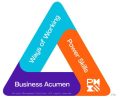
PMI Talent Triangle: Power Skills
Some of the most expensive words in an organization are, “We’re waiting for more clarity.”
The sentence sounds responsible. Sometimes it is. A team may be missing a legal requirement, a material financial assumption, a safety decision, or information that could make a major commitment impossible to reverse.
But I have also watched that same sentence become a hiding place. It can protect a team from making a recommendation, allow every decision to move upward, and create the illusion that waiting is safer than leading.
The cost is not theoretical. Strategy slows down. Capacity sits idle. Executive frustration grows. The PMO becomes the place where uncertainty is reported rather than the capability that helps the organization make better decisions inside it.
Leadership is not the elimination of uncertainty. It is the ability to turn uncertainty into a responsible decision, a focused next step, and useful learning.
When “we need more clarity” becomes a hiding place
PMO and transformation leaders work where uncertainty collects. Strategy may be broad. Funding may be constrained. Priorities may conflict. Sponsors may disagree. Teams may discover that the original plan was built on assumptions that no longer hold.
That does not mean every delay is avoidable. Good leaders know when the organization truly needs more evidence before moving. The problem begins when uncertainty becomes an automatic stop sign instead of something to examine.
A team may already have an instinct about the best direction. It may know which option it would recommend or which part of the solution is stable enough to begin. Yet saying, “I recommend this,” creates ownership. The person may be challenged. The idea may be wrong. Someone may ask for the reasoning.
“We need more clarity” can move that risk to someone else. Now the sponsor must provide the answer. Leadership must decide. The business must finish every requirement. Someone with a bigger title must take responsibility.
This pattern becomes stronger in organizations where mistakes are punished, decision rights are unclear, or people have learned that escalation is the safest career move. PMOs can reinforce it when every field, approval, and scenario is treated as a prerequisite for any movement.
The intent may be risk reduction. The result can be dependency.
Ask the question that surfaces the thinking already in the room
When I hear a team say it cannot move, I often ask: “If you did know, what would you do?”
The question does not pretend the uncertainty is gone. It gives people permission to step outside it for a moment and access the thinking they already have.
The answer usually becomes more specific: “We would probably start here.” “We would choose option B.” “We would test this approach.” “We would build the part we know the customer needs.”
Now the conversation has changed. We are no longer dealing with a vague statement about missing clarity. We have a hypothesis or recommendation that can be evaluated. We can ask what outcome it advances, what assumptions it depends on, what risk it creates, and what evidence would cause us to change direction.
That is decision support.
A real information gap does not always mean no progress is possible
I saw this with a team that had been debating requirements for weeks. Every meeting sounded the same: the business needed to provide more information, the requirements were not complete, and the team should wait.
I asked one question: “If the requirements were perfectly clear tomorrow, what is the first thing you would start building?”
A developer answered immediately: the customer onboarding workflow. Everyone agreed that the workflow would be needed regardless of how the rest of the design evolved.
The team did have unanswered questions. What it had not done was separate those questions from the work that was stable under multiple possible futures.
Starting with the onboarding workflow gave people something real to react to. The work revealed better questions. The early decisions showed where the true gaps were. Progress created clarity.
That was not reckless action. It was a low-regret move that created value and learning without pretending the final solution was known.
Bring a recommendation, not a request for rescue
Some decisions belong to sponsors and executives. Respecting decision authority matters. Handing all the thinking back to the decision-maker is different.
Executives do not need the PMO to make every decision. They need the PMO to make their decisions easier.
Instead of arriving with, “We do not know what to do. Please decide,” bring a recommendation connected to the intended outcome. Explain the assumptions, the risk of moving, the risk of waiting, the tradeoffs, and the date by which a decision is required.
A strong decision statement might sound like this: “Based on the customer outcome we are trying to achieve, we recommend option B. It gives us the fastest way to test the response without committing the full investment. These are the assumptions we need to validate. This is the primary risk. This is the cost of waiting. We need the decision by Friday to protect the next delivery window.”
The team has not removed uncertainty. It has organized it.
This is one of the clearest ways a PMO or transformation office moves from status reporting to strategic decision support. You are not merely escalating an issue. You are helping leaders understand what the issue means and what needs to happen next.
Create a safe learning loop
There is another mistake to avoid. “Do not wait for perfect clarity” does not mean “just start.” Activity is not progress simply because people are busy.
The next move must be responsible, connected to the intended outcome, and designed to produce useful learning. It must also match the consequence of being wrong. A reversible decision can often be tested quickly. A decision that creates legal exposure, affects safety, commits significant funding, or closes off future options deserves stronger evidence and approval.
In The IMPACT Engine, I describe the perfection trap and the value of a minimum viable approach. The goal is not to build the perfect service, process, or solution before anyone can benefit. The goal is to start at a scale that allows you to test, measure, learn, and adapt.
Perfection blocks progress. Uncontrolled action blocks value.
A disciplined learning step answers three questions: What outcome are we trying to advance? What is the smallest responsible move that gives us better information? When will we stop, evaluate the evidence, and decide what comes next?
That last question matters. Without a checkpoint, a pilot can quietly become permanent, a temporary workaround can grow roots, and the organization can continue acting without revisiting the assumptions that justified the work.
Use this three-question sequence in your next meeting
The next time someone says, “We are waiting for more clarity,” do not immediately push the team to move faster. Do not assume the concern is resistance. Use the moment to create better thinking.
Ask: “What do we truly need to know before we can act responsibly, and what could we learn by taking action?”
Then ask: “If you did know, or it was your job to decide, what would you recommend?”
Finally, ask: “How can I personally help accelerate strategy delivery by getting us closer to the answers we need?”
Document the recommendation, assumption, owner, and decision or learning date. Do not leave the meeting with “get more clarity” as the action item.
Clarity is not an action. Identify the information, decision, conversation, or test that will create it.
Leadership creates the conditions for clarity
Uncertainty is the normal environment of strategy delivery. The organizations that move well through it are not the ones that know everything in advance. They are the ones that can separate real risk from decision avoidance, turn incomplete information into a thoughtful recommendation, and create a disciplined next step that produces learning.
Your job is not to wait for clarity. Your job is to help create the conditions where better clarity can emerge.
That is how a PMO or transformation leader becomes useful at the leadership table. You help the organization move without losing sight of the outcome, the risk, or the responsibility that good decisions require.
Press play above to hear the complete Episode 375 teaching and apply the question in your next decision conversation.
P.S. Join me live for a FREE live workshop, Six Moves to Build a High-IMPACT PMO, on Thursday, September 10, from 11:00 a.m. to 1:00 p.m. Eastern. Bring one real strategy delivery challenge, and you’ll leave knowing where to focus first and what to do next. Register now to claim your free seat and join us live.