
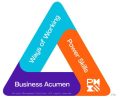
PMI Talent Triangle: Power Skills
This is one of the most personal podcast episodes I have recorded.
For the first time, my son and co-author, Grayson Barnard, joined me on the PMO Strategies Podcast. One of my closest friends, Dawn Mahan, joined us too.
Dawn created the idea of Projectland, wrote Meet the Players in Projectland, and co-edited Projectland Goes to the Movies. Grayson and I wrote the opening chapter of that second book together.
The conversation gave us a chance to talk about friendship, family, baseball, movies, leadership, change, and why serious work does not always have to feel so heavy.
But one lesson sits underneath all of it:
Stop focusing on what looks like good project management and start focusing on what actually helps the team win.
Grayson saw the answer before I did
When Dawn invited me to contribute a chapter to Projectland Goes to the Movies, I knew the chapter needed to connect to strategy, business outcomes, and the work that happens before projects are set up for success.
I did not know which movie to choose.
Grayson did.
We were talking about it over dinner when he told me the answer was obvious: Moneyball.
He saw the connection between the movie and my work immediately. The established baseball model focused on buying players who looked like the right players. The better question was what produced wins. If runs produce wins and getting on base helps produce runs, then the team needed to find people who could get on base.
That shift changed the problem.
The team was not trying to replace three stars with three people who looked like stars. It was trying to replace the outcome those players had helped produce.
That is exactly where many organizations go wrong with projects, PMOs, and transformation work. They protect the familiar inputs, activities, roles, and deliverables without stopping to ask whether those things are producing the outcome the business needs.
A PMO can look successful without helping the business win
I have seen organizations spend months perfecting templates, configuring tools, adding workflow steps, and producing reports filled with data.
The work looks professional. The PMO appears organized. The process is documented. The dashboard is polished.
Then an executive looks at the 22-page report and says, “I only need two things to make this decision. Why can’t I get the two things?”
That is the gap between what looks like good project management and what actually helps the business win.
Templates, tools, dashboards, governance, and process matter. I am not suggesting that we throw them away. They are enabling mechanisms. They create value only when they help people make better decisions, focus capacity, move the right work, manage change, and realize measurable business outcomes.
The tool is not the win.
The completed template is not the win.
The status meeting is not the win.
The win is what those mechanisms enable the organization to do differently.
Find the equivalent of getting on base
Every initiative needs a clear version of getting on base.
This is not necessarily one simplistic metric. It is the closest observable action, decision, behavior, or result that meaningfully advances the business outcome.
For an intake process, getting on base may not be the percentage of requests submitted through the correct form. It may be the organization’s ability to focus limited capacity on the priorities leaders have actually chosen.
For governance, getting on base may not be holding every scheduled meeting. It may be making the right decision before delay destroys the value of the work.
For reporting, getting on base may not be collecting every possible data point. It may be giving an executive the two pieces of information needed to choose a path.
For change, getting on base may not be training completion. It may be the behavior people must adopt for the approved outcome to appear.
For a portfolio, getting on base may not be a page full of green indicators. It may be stopping low-value work early enough to protect capacity for the priorities that matter.
When you identify the equivalent of getting on base, you can evaluate every tool, template, process, role, measure, and meeting against it.
Does this help the team advance the outcome?
Or does it only make us look organized while consuming time and attention?
Individual statistics can work against the team
One of my favorite parts of the conversation is Grayson’s story about bunting.
As a player, he did NOT want the bunt sign. Bunting was not flashy. It could create an out for him. It did not help his personal statistics look exciting. As a mom, that was hard to watch.
But it could move the runner. And advancing the runner is the point.
Once he understood that the purpose was to help the team win rather than protect his own stat line, the play looked different.
Organizations create the same tension when they reward functions, leaders, and teams for isolated measures.
A project leader protects the date even when the scope no longer supports the customer outcome. A department protects its people even when another priority creates more enterprise value. A PMO protects process compliance even when the process is slowing the decision the business needs.
Every individual measure may look rational. Collectively, the organization loses.
PMO and transformation leaders are uniquely positioned to expose that tension because we can often see across projects, functions, dependencies, capacity, and change. That enterprise view matters only when we use it to help people see the team win.
Meet the players who have to create the win
The outcome does not happen through measures alone. People have to understand the game and the part they play in it.
That is where Dawn’s first book, Meet the Players in Projectland, becomes so useful.
Projectland is a different world with different roles, rules, and expectations. The sponsor is represented by the lion. The potential saboteur is the snake. The animal avatars make those roles and behaviors easier to recognize and discuss.
The point is not to label people for fun. The point is to create enough shared language that a sponsor can understand how their behavior affects the room, a team can surface the stakeholder they have been avoiding, and people can agree on what they need from one another.
You cannot help the team win if the players do not understand their roles, protect different definitions of success, or quietly work against the outcome.
Use the movies to make serious lessons easier to carry
Projectland Goes to the Movies expands that idea through 22 movie-inspired strategies for project success.
Moneyball helps us challenge old assumptions, work through constraints, and measure what produces the outcome.
The Italian Job helps leaders think about saboteurs, intuition, trust, and what happens when a member of the team creates a plan of their own.
Apollo 13 gives teams a way to discuss collaboration and adaptation when the original plan is no longer possible.
These lessons can make conversations about strategy, change, leadership, risk, and teamwork easier to enter. They also bring some fun into work that can become painfully serious.
Fun does not lower the standard. As Grayson explained from his experience in baseball, the teams that preserved the joy of the game often performed better together than teams that removed every trace of enjoyment in the name of discipline.
PMO and transformation leaders do difficult work. We carry deadlines, politics, resistance, resource constraints, executive pressure, and the consequences of decisions we may not control.
We can still create environments where people learn, connect, laugh, recognize themselves in a story, and leave the conversation better prepared to do the work.
Run a Getting on Base Review
Choose one initiative, service, or decision that matters and work through these five questions:
- What is the business win we are trying to create?
- What action, decision, behavior, or result is our closest equivalent of getting on base?
- Which work directly helps us advance, and which work only looks complete, professional, or familiar?
- Which Projectland players must understand or change their role for the next move to work?
- What is one play we will run now, knowing the plan may need to change again?
The purpose is not to eliminate every process or choose one metric for the entire organization.
The purpose is to reconnect the work to the win.
Understand the players. Clarify the roles. Use the stories and lessons that help people see the situation. Keep the team engaged through change. Prepare them for the plan not to go according to plan.
And keep your eye on the goal: winning the game by creating the measurable business IMPACT the work was funded to produce.
Listen to Episode 373: Moneyball in Projectland with Grayson Barnard and Dawn Mahan.


P.S. Join me live for Make Your Case on Thursday, August 20, from 12:00 to 1:30 p.m. Eastern. Bring one real strategy delivery challenge and turn it into a clear, leadership-ready Case for Change. Live only. No replays. Owners of The IMPACT Engine join free. Your book is your ticket. Register for Make Your Case.