

PMI Talent Triangle: Business Acumen
PMO and transformation leaders are being asked to help organizations move quickly on AI while many are still positioned as reporting, governance, and oversight functions. That creates a serious gap. When the PMO is brought in only to track activity after decisions have already been made, it cannot address the operating-model issues that determine whether AI creates value or simply adds another layer of complexity.
AI is not automatically simplifying work. In many organizations, it is exposing where priorities, workflows, decision rights, data, and accountability were already unclear. The result can be more agents, more disconnected pilots, more duplicated effort, more tool usage, and more cost without more measurable business IMPACT.
In Episode 372 of the PMO Strategies podcast, I am joined by Paul McNamara, CEO and co-founder of Adaptovate. Paul has led business transformation across global organizations and works with executive teams to scale AI, improve human performance, and build operating models that work in the real world. Our conversation focuses on what PMO and transformation leaders need to understand before AI activity becomes AI-powered chaos.
AI activity is not the same as AI value
One of the most dangerous traps is measuring AI adoption by activity. Leaders may celebrate how many people logged in, how many prompts were run, how many tokens were used, or how many agents were created. Those numbers may show that the technology is active, but they do not show whether the organization is making better decisions, serving customers more effectively, reducing cycle time where it matters, or creating new business value.
Paul described organizations celebrating the number of agents created before asking the harder questions. How much duplication exists? Who maintains the agents? Are they using the same data? Are they giving consistent answers? Are they solving a business problem, or increasing cost without increasing value? A dashboard showing high usage proves that people are using the tool. It does not prove that the business is better.
This is where PMO and transformation leaders need to lean in, not as the AI police, but as the leaders who connect AI work to business outcomes. The goal is not to stop experimentation. The goal is to help the organization understand what the experimentation is meant to accomplish and how it will know when value is being created.
We have seen this pattern before
The AI conversation may feel new, but the transformation pattern is familiar. During Agile transformation, organizations often launched pilots with their best people, gave those teams focus, funding, permission, and executive attention, and then credited the methodology when the pilot worked. In many cases, the deeper reason for success was that the team finally had clarity, decision-making authority, and room to solve a real problem.
That distinction matters because the same thing is happening with AI pilots. The most advanced and enthusiastic users are invited to experiment, the pilot succeeds, and leadership assumes the organization is ready to scale. The pilot may prove that a small group of motivated people can create value under favorable conditions. It does not automatically prove that the broader operating model can support the same result across the enterprise.
Pilots do not scale without the operating model
AI pilots do not fail to scale because people are lazy or resistant. They fail when the organization has not built the conditions required for scale. Paul identified several enablers that need to work together: clear alignment on purpose, processes and tools that support rapid business improvement, empowered decision-making, operating-model clarity, scalable technology and data, capability building, and change management treated as a leadership priority.
Those are not side issues. They are the system around the technology. If data sources are inconsistent, AI outputs will conflict. If teams solve the same problems in isolation, duplication will grow. If leaders measure usage instead of outcomes, people will optimize for usage. If training cannot keep pace with changing tools, capability will fall behind. If change management is reduced to communications, adoption will stall.
The PMO cannot sit downstream and wait to report on AI activity. PMO and transformation leaders need to help shape the operating model that makes AI valuable, including how work is prioritized, how decisions are made, how experiments are governed, how capability is built, and how value is measured.
Move from process efficiency to value creation
Many AI use cases begin with process efficiency, and that is a reasonable place to start. There is real value in removing friction, automating repetitive work, and making painful workflows easier. But efficiency is not the end goal. The larger opportunity is helping the organization serve customers differently, make better decisions, open new lines of business, reduce meaningful cycle time, and spend more capacity on high-value work.
The PMO should not stop at asking, “Can we make this process faster?” The stronger question is, “Does improving this workflow create measurable business IMPACT?” That moves the PMO out of administrative support and into business enablement. It also prevents the organization from using AI to accelerate work that should have been redesigned, simplified, or stopped.
Start with one workflow people hate
One of Paul’s most practical recommendations is to avoid starting with the most exciting AI use case. Start with a workflow people already hate. When people feel the friction directly, the change is more likely to feel useful rather than imposed, and the organization can learn what it takes to introduce AI into real work.
Paul shared an example from a government organization working through a development application process. The initial idea was to improve the planning work, but people resisted because their expertise in that part of the process felt tied to their value. The better starting point was the work everyone disliked: collecting documents, checking them, renaming files, and entering them into the system.
The work was repetitive, frustrating, and slow. Someone who was expected to complete it weekly was doing it monthly because the process was so painful, which added delay to the overall cycle. That is the kind of problem where AI can create immediate value, not because it is flashy, but because it removes friction people already want removed. A useful early win can then build trust, capability, and momentum for more strategic applications.
Support the broader organization, not only the power users
The top 20% of the organization will experiment with AI whether the PMO helps them or not. They will find tools, test use cases, build agents, and practice until they are comfortable. They may not be the people who need the most support. The larger opportunity is helping the other 80% who are uncertain, do not see themselves as technical, or need AI connected to the work they do every day.
The PMO can create shared learning, common standards, clear priorities, practical entry points, and business-focused use cases that allow more people to participate safely. That is how the organization becomes more capable, rather than allowing a small group of power users to move further ahead while everyone else remains overwhelmed.
Use a green, orange, red diagnostic
PMO and transformation leaders are naturally drawn to assessments, but AI readiness does not need another giant diagnostic that delays action. Paul recommends a simple green, orange, red view. Green means an issue is acceptable for now. Orange means it requires attention soon because it could become a blocker. Red means it must be addressed before the organization can move forward safely or effectively.
This approach gives leaders enough structure to make decisions without turning the PMO into the approval bottleneck. It helps the organization see what needs attention now, what can wait, and what creates unacceptable risk if ignored. That is the kind of decision clarity executives need from a PMO.
Lead by example
When I asked Paul where PMO and transformation leaders should begin, his answer was direct: use AI yourself. Start with a simple workflow, experiment, make mistakes, and find one example you can demonstrate. A practical demonstration often does more to build understanding and confidence than another presentation about what AI might eventually do.
PMO and transformation leaders do not need to solve every AI problem this week. They do need enough direct experience to speak credibly about where AI removes friction, where it creates risk, and how it connects to strategy, workflow, capability, governance, and value. AI transformation is a strategy delivery challenge because it changes how work is prioritized, funded, governed, staffed, measured, and adopted.
The PMO opportunity is significant. You can help the organization avoid vanity metrics, stop confusing pilots with scale, reduce duplication, make AI accessible to the broader workforce, connect investments to business outcomes, and redesign workflows so the technology actually helps. The greatest risk is not simply falling behind on AI. It is rushing forward without the operating model, decision clarity, capability, and value focus required to make AI work.
Press play above to listen to the full episode and learn how PMO and transformation leaders can cut through AI chaos, scale what works, and turn AI activity into measurable business IMPACT.

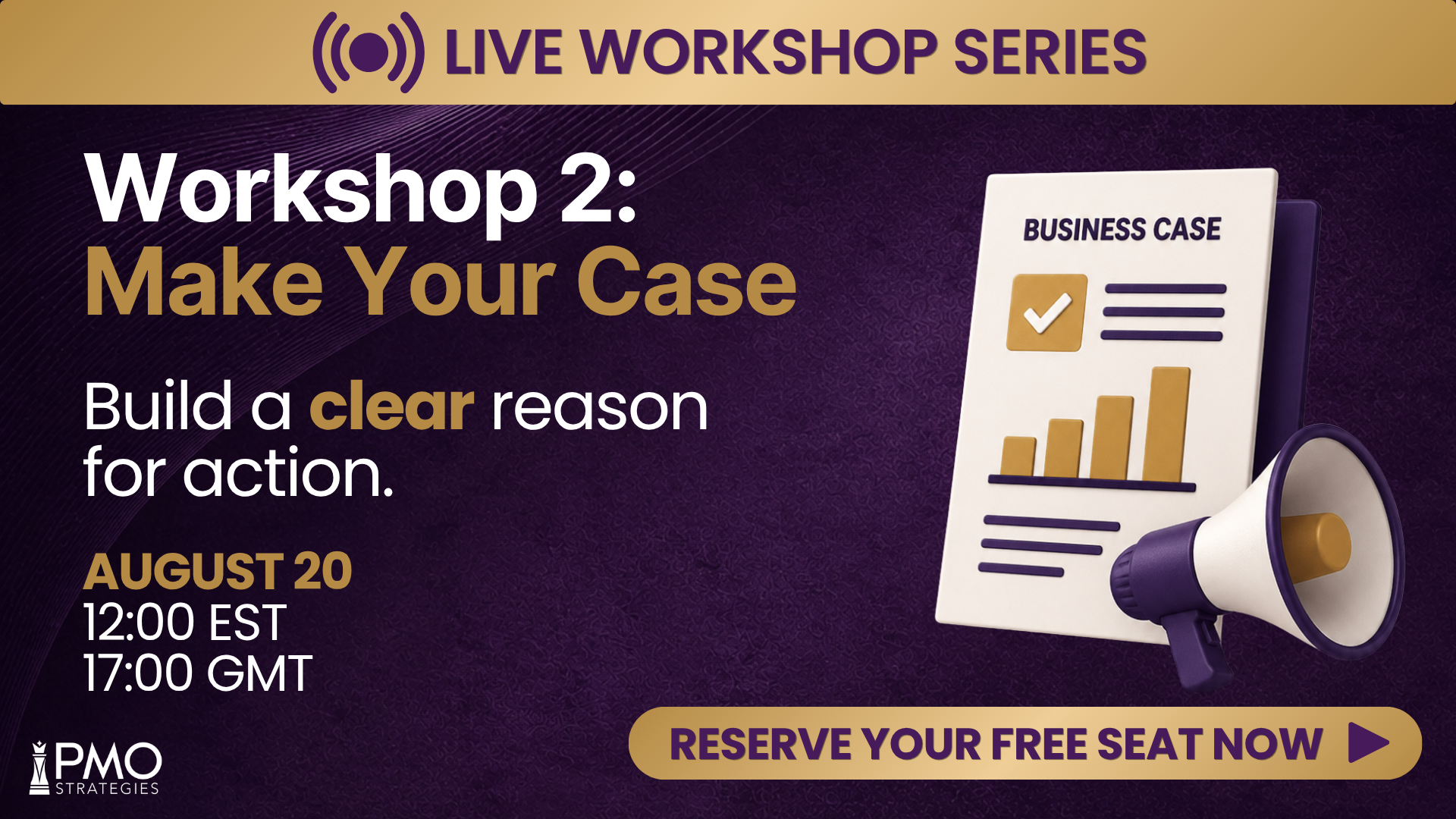
P.S. The next IMPACT Application Lab is Make Your Case on August 20. Inside this free live workshop, I will help you turn one real strategy delivery challenge into a clear, leadership-ready Case for Change you can use in the room. It is live only with no replays and free for everyone who owns The IMPACT Engine. Your book is your ticket. Register for Make Your Case.