What Executives Really Think About Your PMO (And What to Do About It) with Rich Smith

PMI Talent Triangle: Business Acumen
Your PMO is working hard. That is not an issue. The issue is that executives cannot see the connection between what your team does every day and the outcomes the business is trying to drive. And if that connection is invisible to them, your PMO is invisible to them.
Rich Smith has been on both sides of that conversation. As a Chief Marketing Officer and growth strategist with over 25 years of experience leading digital transformation and revenue strategy, he has led transformation efforts and served as the executive customer of PMO teams across multiple organizations. He knows what executives are thinking in those quarterly reviews. He knows why budgets are cut. And he came on the PMO Strategies podcast to say what most executives will not say out loud.
The Language Problem No One Is Talking About
Rich made a point in our conversation that stopped me cold. He said that PMOs fall into the same trap as marketing departments. They speak their own language and assume the people making decisions understand what that language means for the business.
Marketers talk about page views, engagement rates, and follower counts. Project managers talk about timelines, milestones, and deliverable completion. Rich calls these second-order metrics. They are things that lead to outcomes. They are not outcomes themselves.
When you walk into an executive meeting and lead with these numbers, here is what is happening on the other side of the table. The CEO is thinking: Is this making me money? The CFO is thinking: Is this saving me money? And because you have not answered either question, they nod politely and move on to the budget line that does answer those questions.
The fix is not a new reporting template. The fix is a different way of thinking about your work from the moment a project starts. Rich put it plainly: there is always a way to connect a project to a business outcome. If you cannot find one, the business probably should not be doing the project.
The 90-Day Chunk Strategy That Keeps Projects Funded
One of the most practical frameworks Rich shared was what he calls chunking. If you have an 18-month transformation initiative, executives will support it enthusiastically in the first quarter and quietly defund it by the third when short-term pressures mount.
The reason is not politics. It is human psychology. Rich explained that executives are wired to discount future outcomes in favor of present certainty. When earnings are missing and the board is asking hard questions, the long-term investment that is six quarters away starts to feel very optional.
The way to fight this is to break the 18-month outcome into 90-day milestones that each demonstrate measurable progress toward the business goal. Not project milestones. Business milestones. When your quarterly check-in shows executives that you are on track toward a revenue or cost outcome they care about, cutting your project becomes a painful decision instead of an easy one.
That is the difference. Not whether your project gets cut. Whether it is an easy cut or a hard one.
Risk Framing Gets Funded Faster Than Gain Framing
This insight from Rich is one that every PMO leader needs to internalize right now. When you are making the case for a new initiative, the instinct is to lead with what you will gain. We will increase revenue by this amount. We will reduce costs by this amount. That framing works, but it is not the most powerful framing available to you.
Executives are risk-averse by nature. Rich pointed to legal, finance, and compliance as examples: the departments that almost always get the budget they request. They do not lead with gain. They lead with risk. If we do not invest here, here is what happens to us.
The same reframe is available to you. When you are building the case for your next initiative, build two arguments: what you will gain and what you will lose if you do not act. Lead with the risk. The funding conversation will go differently.
Why Your Executive Sponsor Is Not Enough
Most PMO leaders celebrate when they land an executive sponsor. Rich would say that is where the complacency starts. A single executive sponsor is a single point of failure. If that person leaves the organization, changes roles, or loses political capital, your project is exposed.
The way to build real protection for your work is to bring other executives in from the beginning. Rich described it as bringing stakeholders from finance, marketing, operations, and other functions into the strategy conversation early. Not to inform them after decisions are made. To get their input before decisions are made.
This accomplishes two things. First, it helps you connect your project to business outcomes across multiple departments, which makes the project harder to cut from any one direction. Second, it gives those executives skin in the game. They helped shape the strategy. They have a reason to want it to succeed. When budget conversations happen, you have advocates you did not have to ask to advocate.
Asking Questions Is a Power Move
This part of our conversation surprised me because Rich articulated something I figured out early in my career but never had language for. He said that executives do not expect you to know everything. What they expect is for you to be curious enough to find the answers.
Asking an executive for their input, their advice, their perspective on what success looks like: this is not a weakness. It is a strategy. The moment they give you advice; they are invested in your success. They helped build what you are building. They want it to work.
Rich cited the Ben Franklin effect to make the point. Franklin had an adversary in the legislature, someone who fought him on almost everything. Franklin borrowed a book from the man. After that, the man became an advocate. When you ask someone to help you, you give them a reason to like you, because we do not help people we dislike. Our brains create consistency by deciding we must have liked them all along.
Use this. Build your support system through genuine questions and honest curiosity. The executives who seem most intimidating are often the ones who respond most generously when you ask for their guidance.
The Data Problem: Information Your Executives Can Actually Absorb
Here is what Rich said that brought everything together for me. Executives are not ignoring your reports because they are too busy. They are ignoring your reports because the data is not framed for them. It is framed for you.
He put it this way: if a pharmaceutical company creates a drug, the body cannot absorb, the drug does nothing. It passes through the system. If you are creating data and reports that executives cannot absorb because the format, language, and framing are not designed for how they think, your work is passing through the system too.
The question to ask is: what is the user interface? Steve Jobs understood that there was an enormous amount of complexity inside an iPhone. His obsession was making that complexity invisible to the user. The interface was elegant, simple, and built entirely around what the user needed to do with it.
Your reporting, your executive updates, your strategy communications: these are your user interface. If they are not designed around what your executives need to decide, they are noise. And noise does not get funded.
What the PMO of the Future Looks Like
When I asked Rich to describe the PMO of the future, his answer was not about technology or methodology. It was about design. Specifically, the design of the interface between the PMO and the executive team.
The PMOs that will thrive are the ones that make complexity simple and elegant for the people who need to make decisions. They do not dump data. They translate it. They do not report activity. They connect it to outcomes. They do not wait to be asked for input. They bring insight before the question is asked.
That PMO is not a reporting function. That PMO is a strategy partner. And that is exactly what the executives in your organization are waiting for.
You Are Not Alone. And That Is the Point.
One of the most important things Rich said in this episode is that this is not a PMO problem. Marketing departments face the same credibility challenge. Sales teams face it. Operations face it. The struggle to connect functional work to business outcomes is universal.
But here is what makes your PMO’s position unique. You sit at the center of strategy execution. You see what every department is working on. You understand interdependencies. You are the most capable of connecting the dots between what the business is doing and what the business is trying to achieve.
The PMO that learns to translate that visibility into executive language does not just survive budget cuts. It becomes a function that prevents them.
Press play above to hear this conversation in full. Rich is direct, practical, and completely aligned with what every IMPACT Driver needs to hear right now.

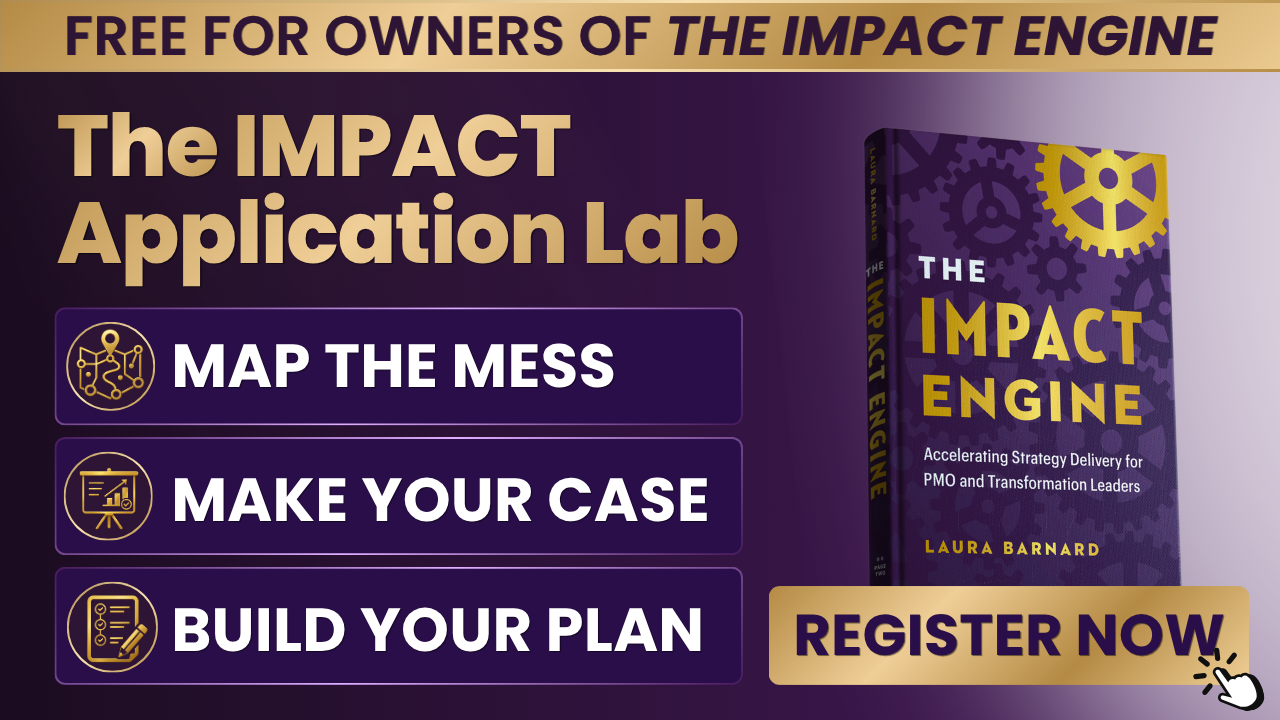
P.S. The first IMPACT Application Lab workshop is almost here! Map the Mess will help you take one real strategy delivery challenge and identify what is actually getting in the way.
This three-part series is FREE for everyone who owns The IMPACT Engine. Your book is your ticket.

 Join today by ordering your copy of the book or registering for the IMPACT Insiders book club!
Hey there, IMPACT Driver!
Thanks for taking the time to check out our podcast and blog.
I welcome your feedback and insights!
I’d love to know what you think and if you love it, please leave a rating and review in your favorite podcast player.
You can also complete this survey to tell us more about you and get my advice on how to take your next steps toward high-IMPACT!
Warmly,
Laura Barnard