
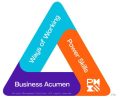
PMI Talent Triangle: Ways of Working
Why More Reporting Does Not Lead to Better Decisions
Most organizations are not suffering from a lack of reports.
They have dashboards, spreadsheets, status updates, reporting tools, analytics platforms, executive summaries, and teams of people working hard to turn activity into information. Yet many leaders still walk into meetings without the trusted data they need to make fast, informed decisions.
That disconnect creates real friction across the organization.
Decisions slow down.
Priorities become harder to evaluate.
Teams spend enormous time producing updates while executives continue searching for information they can actually trust.
The issue is not always a lack of data. More often, it is fragmented systems, disconnected reporting, and inconsistent information flowing across the organization.
That is the problem Scott Ambler and I explored in this episode of the PMO Strategies podcast. Scott is a recognized thought leader, international keynote speaker, former Vice President at PMI, and co-author of 31 books, including his latest, Not Just Data: How to Deliver Continuous Enterprise Data. His work focuses on a topic many organizations know is important but still struggle to address: how to build and operate continuous enterprise data pipelines that support better decision-making at scale.
This is not just an IT issue. It is a strategy delivery issue. If leaders cannot access accurate, current, trusted information when they need it, the organization’s ability to make decisions and execute strategy will suffer.
The reporting problem most organizations still have
Many organizations respond to decision-making frustration by adding more reporting. They build another dashboard, create another report, add another spreadsheet, or ask teams for more updates. The assumption is that more visibility will solve the problem.
But more reporting does not automatically create better decisions.
In many organizations, the same information exists across multiple systems, spreadsheets, databases, and operational tools. Different teams rely on different sources. Metrics are defined differently. Numbers do not always align. Leaders enter meetings with conflicting information, and too much of the conversation gets spent debating which version of the data is accurate.
That is not decision-making. That is organizational drag.
Scott shared a striking example from his client work. One organization had 44 people whose entire job was producing reports. Forty-four people dedicated to generating information. And the executives in that organization still said they did not have what they needed to make decisions.
That is not a reporting problem.
That is a systems problem.
The reports existed. The trusted information did not. Teams were spending effort generating output, but leaders still did not have decision-ready data. That is the gap organizations must start addressing if they want strategy execution to move faster.
Why fragmented data slows strategy execution
Strategy execution depends on decision flow. Organizations move faster when leaders can access accurate information, understand what it means, and make decisions with confidence. When information is delayed, incomplete, inconsistent, or not trusted, execution slows across the entire system.
This is one of the reasons many organizations struggle to close the gap between strategy and execution. Projects are often blamed for delays, but the underlying issue is frequently operational. Leaders cannot make decisions efficiently because the information needed to support those decisions is fragmented across disconnected systems.
Scott described how organizations have spent years building silo applications, silo reports, and silo databases. Over time, those disconnected systems create increasing complexity and make it difficult to establish a reliable enterprise view of what is actually happening.
For PMO and transformation leaders, this matters because you are often closest to where the friction shows up. You see where reporting breaks down. You see where leaders do not trust the numbers. You see where teams spend more time reconciling data than solving problems. And you see how slow decisions become slow execution.
If your portfolio data is unreliable, your prioritization decisions are unreliable. If your resource data is incomplete, your capacity decisions are incomplete. If your initiative status is based on inconsistent information, your executive conversations will be built on shaky ground.
This is why data quality is not a technical issue. It is a leadership issue.
AI is exposing the cracks faster
Many organizations are racing to adopt AI, but AI does not solve poor information quality. It accelerates whatever already exists underneath the business.
Scott reframed the old phrase “garbage in, garbage out” in a way that should stop leaders in their tracks. With AI, the issue can become “garbage in, landfill out.”
That matters because AI can generate analysis, content, recommendations, and outputs at enormous speed. But if the underlying information is inconsistent, outdated, biased, incomplete, or inaccurate, the organization simply produces bad outputs faster and at greater scale.
AI does not remove the need for trusted enterprise data. It increases the urgency.
Organizations cannot treat data quality as a secondary operational issue while expecting AI to improve decision-making. If the systems feeding AI are fragmented, the results will reflect that fragmentation. If the data being used to train or operate AI is low quality, the outputs will be low quality too.
This is where PMO and transformation leaders need to be especially alert. If your organization is investing in AI, automation, analytics, or enterprise modernization, the data foundation underneath those investments matters. The more visible and exciting AI becomes, the more important the underlying data infrastructure becomes.
It may not be the flashy work. But it is the work everything else depends on.
Continuous enterprise data is an operating capability
One of the most important shifts in this conversation is that enterprise data management cannot be treated as a one-time project.
Many organizations approach data initiatives as isolated efforts.
Build a dashboard.
Clean up a report.
Solve a specific reporting issue.
Create a short-term data warehouse.
These efforts may create temporary improvements, but they rarely solve the larger operating model problem.
Continuous enterprise data pipelines require a different way of thinking. Organizations need systems capable of continuously integrating, validating, updating, and delivering trusted information to the people making decisions. They also need operating models that support ongoing evolution instead of periodic, one-off reporting projects.
This distinction is important because leaders do not always need a multi-month project to answer a decision question. Sometimes they need a small improvement delivered quickly so they can make the decision in front of them. If every data request becomes a long project cycle, the organization cannot move at the pace decision-making requires.
Scott compared this to operational support. If your laptop fails, you do not expect the organization to launch a three-month project to get you a replacement. You expect the operating model to be capable of responding quickly. Enterprise data needs to work with a similar level of operational responsiveness. When leaders need trusted information, the organization should not be stuck waiting months for a report that supports a decision needed now.
The ability to continuously improve information flow is a strategy delivery capability.
Data fluency also matters
Even when the right data exists, leaders still need to understand what it means.
Scott and I also talked about data fluency, which is often overlooked. A dashboard may show twenty indicators, but do leaders understand the relationship between those numbers? Do they know what action the data is pointing toward? Do they understand the implications, the risk, and the decision in front of them?
Data is not useful simply because it is available. It becomes useful when it supports understanding and action.
This is another reason PMO and transformation leaders are important in the data conversation. You are often translating between strategy, execution, operations, and leadership. You can help ensure data is not just presented, but interpreted in a way that supports decisions.
The goal is not to produce more noise. The goal is to help leaders see what matters, understand what is changing, and make better decisions faster.
What PMO and transformation leaders should do now
PMO and transformation leaders should look at this issue through two lenses.
First, if your organization has data-related work in the portfolio, protect it. Data infrastructure may not always be the most exciting initiative, but it may be the foundation that determines whether other transformation, AI, and strategy execution work succeeds. If that work keeps getting deprioritized because something flashier comes along, the organization may continue building new capabilities on top of weak foundations.
Second, look at your own portfolio data. The data used to make strategic planning, prioritization, funding, capacity, and resource decisions is its own data ecosystem. If that data is unreliable, every decision about where to invest and what to prioritize becomes harder.
Ask the uncomfortable questions. Do executives trust the portfolio data they are seeing? Are teams using the same definitions? Do reports align across systems? Are leaders confident in the information used to make decisions? Are people spending more time validating the data than acting on it?
If the answer is no, that is the starting point.
Organizations do not improve execution by generating more reports. They improve execution when leaders have the trusted information they need to make decisions confidently and quickly. That requires better systems, better operational flow, better data fluency, and a stronger approach to enterprise data management.
Better decision-making does not start with more dashboards. It starts with trusted enterprise data that supports decisions, action, and measurable IMPACT.
Press play above to listen to the full episode and learn why continuous enterprise data matters for PMO, transformation, AI, and strategy delivery leaders.

P.S. The IMPACT Application Lab starts soon.
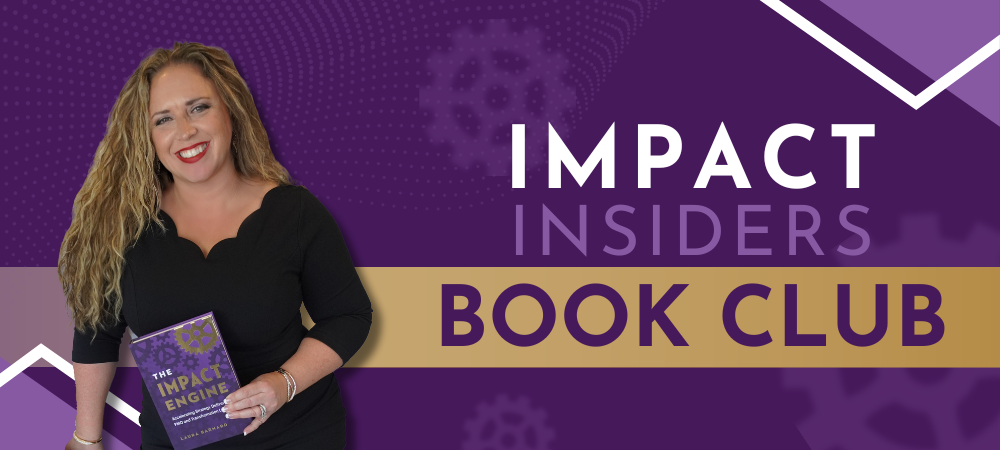
Inside the IMPACT Insiders Book Club, I’m hosting a free three-part live workshop series to help you apply The IMPACT Engine to one real strategy delivery challenge.
We’ll Map the Mess, Make Your Case, and Build Your Plan.
Your book is your ticket.